Home Why subtitles matter
sound off is the default on every feed
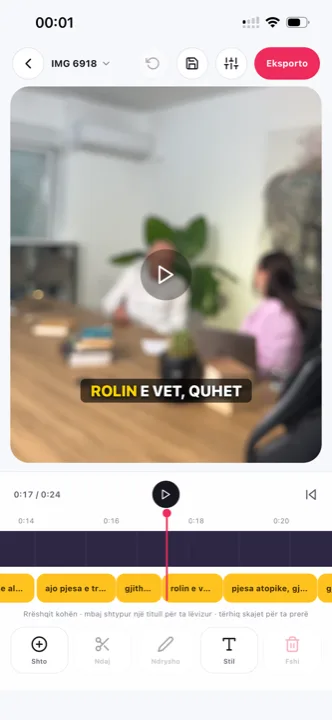
Why subtitles matter comes down to one habit: most feed video is watched with the sound off. A video without them is judged on the picture alone, and the picture rarely carries the point.
From €4.99/month · 300 minutes of video · cancel any time
Or work on the web →
Phones default to mute in the feed, and people scroll in trains, offices and beds. The first three seconds decide whether a viewer stays, and in those seconds the only thing that speaks is text on the picture.
TikTok, Instagram and YouTube rank by how long people watch. Subtitles keep the viewer who would have scrolled past, and every extra second tells the platform to show the video to more people.
The World Health Organization counts over 430 million people with disabling hearing loss. Add the viewers watching in a second language, who understand written text better than fast speech, and a subtitled video reaches an audience the audio never could.
YouTube indexes the words in a subtitle file; a feed video with burned-in text is read by the platform’s own recognition. Either way, a subtitled video can be found for what it says — an unsubtitled one only for its title.
The hook is read, not heard. A viewer with the sound off decides on the text and the picture.
Word-timed subtitles keep the eye on the frame and the viewer in the video, especially for fast speech and accents.
A subtitled clip is forwarded more, because the receiver can watch it wherever they are — in a meeting, in a queue.
Subtitled video keeps working in search and in reposts, long after the original push.
Platform captions are better than nothing and worse than your own. They are off by default on many phones, often wrong on names and in any language but English, and they don’t leave the platform with the video. Burned-in subtitles are on for everyone, in the style you chose, on every repost. How to make each kind is on add subtitles to a video; the TikTok-specific route, both ways, is on how to add captions on TikTok.
A video made in one language reaches another market for the cost of a translation. For a small business selling across a border, or a creator with family abroad, a second subtitle track is the cheapest audience they will ever buy.
By hand, the better part of an hour for a three-minute video. With an automatic tool, about twenty seconds and a read-through. Titro does the latter, on the phone or in the browser, in English, German and Albanian — from €4.99 a month for 300 minutes. If you want to compare tools first, nine auto subtitle apps are set side by side with their prices and limits; the feed-by-feed specifics are on TikTok, Reels and Shorts.
Platform analytics show watch time; they do not show circumstances. The commuter on a train, the person in an open office, the parent beside a sleeping child — contexts where sound is simply not available, and where the subtitled video plays on while the unsubtitled one is scrolled past. Add the 430 million people the World Health Organization counts with disabling hearing loss, and the viewers watching in their second language who follow written text more comfortably than fast speech, and “sound off” stops being an edge case. It is a large share of every audience, and it is invisible in the dashboard precisely because the subtitled video kept those viewers and the unsubtitled one never saw them arrive.
Not with the back catalogue. Caption everything new from today, in one saved style, so the habit costs twenty seconds per clip — the mechanics are on add subtitles to a video. Then go back only for the evergreen pieces that still pull views, where the subtitle work keeps paying. Burn captions in for feed video; upload the .srt alongside YouTube long-form so viewers keep the choice and the text gets indexed. The compounding is the point: a subtitled video keeps working in search, in reposts and in forwards long after its first push, which is why the habit beats the one-off cleanup.

Every platform reports that captioned video is watched longer on mute — and most feed video is watched on mute. The size of the effect varies by content, but the direction doesn’t.
Burned-in for short feed video and ads; a subtitle file for long-form YouTube where viewers may want to turn it off. Titro exports both.
In everyday use, yes. Strictly, captions also describe sounds for deaf viewers, while subtitles carry the speech, often in another language. For social video the word doesn’t matter; the text does.
Upload the video to Titro, wait about twenty seconds, pick a style and export. The step-by-step is on how to add subtitles to a video.
Indirectly: YouTube indexes uploaded caption files, so a video can rank for what is said in it, and the watch-time gains feed every platform’s ranking. A clip discoverable only by its title is leaving its own words unused.
Almost none on feed video. The one real cost is covering the picture — which is a placement problem, not a reason to skip the text. Keep captions in the safe band, use a boxed style over busy footage, and the trade-off disappears.
Upload it now and see it finished before your coffee’s done.